Reading time: 9 minutes By Naim Mortgage | Mortgage Consultant, Setia Alam
Your CCRIS report is the first thing every Malaysian bank checks when you apply for a home loan. And most applicants have no idea what’s in it — until the rejection letter arrives. These 5 mistakes are responsible for the majority of home loan rejections in Malaysia. Check how many apply to you before you submit a single application.
There’s a moment every Malaysian home buyer dreads.
You’ve found the property. You’ve saved for the deposit. You sit across from the bank officer, hand over your documents — and then they pull up two reports you barely understand.
CCRIS. CTOS.
Two acronyms that can make or break your home loan application. Yet most Malaysians have never checked either one — until it’s too late.
I’ve seen it happen too many times. A buyer with a stable job, decent income, and genuine excitement about their first home — rejected because of a late payment they forgot about three years ago. Or worse, an error on their credit report they didn’t even know existed.
This guide will change that. By the end, you’ll understand exactly what CCRIS and CTOS are, what banks see when they check your profile, and most importantly — what you can do to maximise your chances of approval.
What is CCRIS?
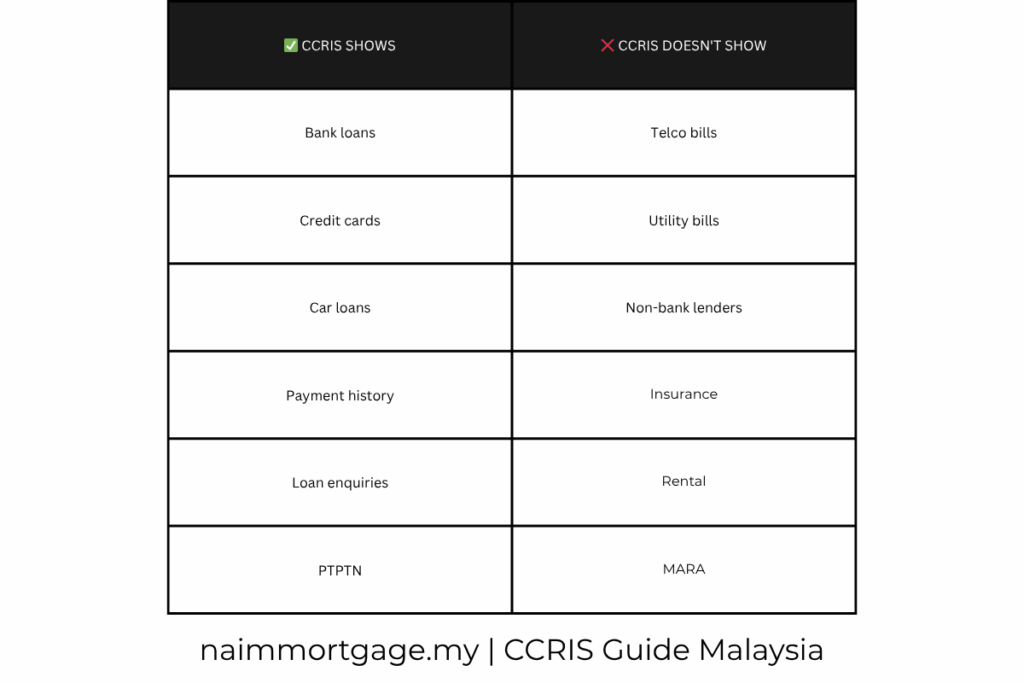
CCRIS stands for Central Credit Reference Information System. It is managed by Bank Negara Malaysia — the country’s central bank.
Think of CCRIS as the official government record of your borrowing and repayment history in Malaysia. Every bank, finance company, and licensed lender that is regulated by Bank Negara is required to report your credit activity to CCRIS every month.
What information does CCRIS contain?
Your CCRIS report shows:
- Outstanding loans — all your current active loans (home loan, car loan, personal loan, credit cards, overdrafts)
- Repayment history — whether you paid on time or late, for each loan, for the past 12 months
- Special attention accounts — loans that have been restructured or rescheduled
- Legal actions — any court action taken against you by a financial institution
- Loan applications — all recent enquiries made by banks when you applied for credit (shown for 12 months)
What CCRIS does NOT show
This is important — CCRIS only covers financial institutions regulated by Bank Negara. It does not show:
- Telco bills (Maxis, Celcom, Digi)
- Utility bills (TNB, Syabas)
- Non-bank lenders
- Rental/Insurance
- Hire purchase from non-bank companies
How to check your CCRIS for free
You can check your CCRIS report for free in two ways:
- eCCRIS online — visit
eccris.bnm.gov.myand register with your MyKad details - Bank Negara branches — walk in to any BNM branch with your MyKad
Your report is free and available instantly online. There is no reason not to check it before applying for any loan.
What is CTOS?
CTOS stands for Credit Tip-Off Service. Unlike CCRIS, CTOS is a private credit bureau — not a government system.
CTOS compiles a much broader credit profile by pulling data from multiple sources:
- Bank Negara CCRIS data
- Court and legal records (bankruptcy, court judgements, legal suits)
- The Companies Commission of Malaysia (SSM) — company directorships
- PTPTN records
- Trade references
- Dishonoured cheques
- Telecommunications companies (in some cases)
Why CTOS matters
CTOS often paints a fuller picture than CCRIS alone. A person might have a clean CCRIS but a legal judgement against them from a non-bank dispute — and CTOS would capture that.
Many banks now check both CCRIS and CTOS as standard procedure for home loan applications.
How to check your CTOS report
Unlike CCRIS, CTOS is not completely free. You can:
- Get a basic MyCTOS Score report for free at
app.ctos.com.my - Get a detailed report for a small fee (around RM25)
I strongly recommend paying for the detailed report before applying for a home loan. RM25 is a small price to avoid a surprise rejection.
CCRIS vs CTOS: Key Differences
| CCRIS | CTOS | |
|---|---|---|
| Managed by | Bank Negara Malaysia | Private company |
| Free to check | Yes (fully free) | Basic report free, full report paid |
| What it covers | Bank loans and credit facilities | Broader — includes legal records, telcos |
| How often updated | Monthly | Varies by data source |
| Banks check it | Always | Most banks, especially for larger loans |

What Banks Actually Look For
When a bank officer pulls up your CCRIS and CTOS, here is exactly what they are examining:
1. Payment history — the most important factor
Banks look at whether you paid your existing commitments on time. On your CCRIS, each loan shows a payment status for each of the last 12 months:
- “0” — paid on time ✅
- “1” — 1 month late ⚠️
- “2” — 2 months late ❌
- “3” and above — serious concern ❌❌
Even a single “1” (one month late payment) can cause a stricter bank to reject your application or offer you a lower loan margin. Multiple late payments are serious red flags.
2. Number of recent enquiries
Every time you apply for a loan — any loan — the bank checks your CCRIS and this creates an “enquiry” record. These enquiries are visible to all other banks for 12 months.
If a bank sees 5 enquiries in the past 3 months, they immediately wonder: why has this person been applying everywhere? What are other banks seeing that made them reject this person?
This is why you must not apply to multiple banks at the same time without a strategy. Every failed application makes the next one harder.
3. Total outstanding debt
Banks calculate your Debt Service Ratio (DSR) — the percentage of your income committed to debt repayments. Your CCRIS shows all your outstanding loans, which the bank uses to calculate this ratio.
A high total outstanding debt, even if all payments are on time, can lead to rejection if it pushes your DSR above the bank’s limit.
4. Legal records (CTOS)
Any bankruptcy proceedings, court judgements, or legal suits will appear on your CTOS report. These are very serious and will result in rejection from virtually all banks until resolved.
If you are an undischarged bankrupt in Malaysia, you cannot apply for a home loan. Full stop.
Common CCRIS and CTOS Problems — and How to Fix Them
Problem 1: Late payment records
The fix: Unfortunately you cannot remove accurate late payment records — they stay on CCRIS for 12 months from the date of the late payment. What you can do:
- Bring all accounts fully current immediately
- Set up auto-payment for every commitment going forward
- Wait for the 12-month period to pass before applying for a major loan
- Work with a consultant to find banks with more flexible policies for minor historical late payments
Problem 2: Too many recent enquiries
The fix: Stop applying for any credit — loans, credit cards, everything — for at least 6 months. Let the enquiry history cool down before your home loan application.
Problem 3: Errors on your report
This happens more often than you’d think. A bank may have incorrectly reported a payment as late, or there may be an account on your report that doesn’t belong to you.
The fix:
- For CCRIS errors — write a formal dispute letter to Bank Negara Malaysia or contact the specific financial institution that made the incorrect report
- For CTOS errors — submit a dispute at
app.ctos.com.mywith supporting documentation
Always keep receipts and proof of payment for all your financial commitments. They are your evidence if a dispute arises.
Problem 4: High outstanding debt
The fix: Before applying for a home loan, strategically settle smaller debts. Focus on:
- Personal loans with high monthly instalments
- Credit cards (even if you pay in full monthly, the credit limit appears as a potential liability to some banks)
- Any loans with less than 12 months remaining — some banks allow these to be excluded from DSR calculation
Problem 5: PTPTN default
PTPTN appears on both CCRIS and CTOS. If you have been defaulting on your student loan repayments, this will affect your home loan application.
The fix: Set up a repayment plan with PTPTN immediately. Even small regular payments show good faith and can improve your profile over time.
The Golden Rule: Check Before You Apply
The single most important piece of advice I give every client:
Check your CCRIS and CTOS before you apply for anything.
Not after you’ve been rejected. Not while the bank is processing your application. Before.
Here’s a simple pre-application checklist:
✅ Pull your eCCRIS report — check every account, every month of payment history ✅ Pull your CTOS report (paid version) — check for any legal records or surprises ✅ Calculate your own DSR — add up all monthly commitments divided by gross income ✅ Check your income documentation — are your payslips, EPF, and tax returns in order? ✅ Consult an independent mortgage consultant — before submitting anywhere
That last point is important. An independent consultant reviews everything before any application is submitted — protecting your CCRIS from unnecessary enquiries and maximising your chances of approval the first time.
What a “Good” CCRIS Profile Looks Like
If you want the best chance of home loan approval, here is what banks want to see:
- All “0”s in your payment history for the past 12 months — no late payments at all
- Fewer than 3 enquiries in the past 6 months
- DSR below 60% after including the new home loan instalment
- No legal records on CTOS
- PTPTN being paid regularly (or fully settled)
- Stable income documentation for at least 6 months
If your profile matches this — you are in a strong position and most banks will consider you favourably.
If your profile has issues — don’t panic. Every problem has a solution. It just requires the right strategy and sometimes a little patience.
Real Example: How a Clean CCRIS Gets You a Better Deal
Two buyers apply for the same RM500,000 property. Both earn RM6,000 a month. Both have similar DSRs.
Buyer A has a clean CCRIS — all “0”s for 12 months, only 1 recent enquiry. Buyer B has two “1”s (one month late) on a car loan from 8 months ago, and 4 recent enquiries.
Buyer A gets offered 90% margin of financing at the best available rate. Buyer B gets offered 85% margin at a higher rate — or rejected outright by stricter banks.
On a RM500,000 property, that difference in margin means Buyer B needs an extra RM25,000 in cash for the downpayment. The higher interest rate adds thousands more over the loan tenure.
Your CCRIS health is worth protecting. Treat it like your financial reputation — because that is exactly what it is.
Your Next Step
Before you apply for a home loan — or if you’ve already been rejected and want to understand why — we offer a free CCRIS and CTOS review consultation.
In 30 minutes we will:
- Go through your CCRIS and CTOS reports with you
- Identify any issues that could affect your application
- Calculate your actual DSR
- Give you a clear, honest picture of your current eligibility
- Recommend a specific strategy and timeline for your application
This consultation is completely free. We are only paid when your loan is successfully approved.
📞 Call or WhatsApp: 011-1100 1145 🌐 Website: naimmortgage.my 📍 Based in Setia Alam, serving all of West Malaysia
Frequently Asked Questions
How long do late payments stay on CCRIS? Late payment records remain on CCRIS for 12 months from the date of the late payment. After 12 months they drop off automatically.
Can I remove accurate negative records from CCRIS? No — accurate records cannot be removed. You can only dispute incorrect records. The best approach is to bring all accounts current and wait for the 12-month period to pass.
Does checking my own CCRIS affect my credit? No. Checking your own CCRIS or CTOS is a “soft enquiry” and does not appear as a loan application. Only when a bank checks your CCRIS during a loan application does an enquiry appear on your record.
My CTOS shows a court case I know nothing about. What should I do? Dispute it immediately through CTOS’s dispute process at app.ctos.com.my. Bring supporting documentation. Also consider consulting a lawyer if there is a genuine case against you that you were unaware of.
I have bad CCRIS. Can I still get a home loan? It depends on the severity and age of the issues. Minor historical late payments may be acceptable to certain banks, especially if everything else is strong. Serious issues like bankruptcy or multiple recent late payments will require more time and a specific strategy. Contact us for an honest assessment of your specific situation.
Does PTPTN affect my home loan application? Yes. PTPTN appears on both CCRIS and CTOS. Regular repayment of PTPTN is important. A default will negatively affect your profile.
Naim Mortgage is an independent home loan and refinancing consultant based in Setia Alam, Shah Alam, serving clients across West Malaysia. Contact us at 011-1100 1145 or visit naimmortgage.my.
✅ Download our free Home Loan Readiness Checklist — know if your documents, CCRIS and DSR are ready before applying.
👉 naimmortgage.my/free-checklist
🧮 Or calculate your DSR instantly and find out how many banks will consider you.
👉 naimmortgage.my/dsr-calculator
Both are free. No registration. No obligation.
Independent mortgage consultant and Senior Consultant at Strategic Mortgage Advisory, based in Setia Alam, Shah Alam. A Material Engineering graduate from Université de Pau, France, and HRDF Certified Trainer, Naim has helped thousands of Malaysians navigate home loan approvals, refinancing, and difficult cases —including bad CCRIS, self-employed applicants, and previously rejected borrowers. Recognised as a Top 5 Best Consultant in his field. Consultation is completely free — he only succeeds when you do.